AI-Powered Seach
Get Your Site Updated… or miss the growing shift
WebMCP is one of those developments that sounds deeply technical until you understand what it actually does to the relationship between your website and the people, or rather the systems, trying to use it. This is not a developer story. It is a brand story. And if you run a business with an online presence, it is your story too.
Your Website Has a New Kind of Visitor
When you built your website, you built it for humans. Someone types a search query, clicks a link, reads your content, fills out a form, and either contacts you or moves on. That is the loop the entire web has been designed around for thirty years.
That loop is not disappearing. But a second loop is forming alongside it. AI agents are beginning to browse the web on behalf of users. Google shipped Chrome Auto Browse in January 2026, powered by Gemini. OpenAI launched Atlas with Agent Mode. Perplexity released Comet for full-task agentic browsing. These are not experiments running in a lab. They are products with real users, and they are using the web differently than humans do.
A human reads your page and decides what to do. An AI agent reads your page, tries to figure out what it can do, and then attempts to do it. That distinction, small as it sounds, changes everything about how your website needs to be structured.
What Is WebMCP?
WebMCP stands for Web Model Context Protocol. It is a proposed browser-level standard, developed jointly by Google’s Chrome team and Microsoft’s Edge team through the W3C Web Machine Learning Community Group, that lets any webpage declare its capabilities as structured, callable functions for AI agents.
In plain terms: instead of an AI agent having to screenshot your page, guess which button does what, and hope it gets the right result, WebMCP lets your website announce its own instructions. It says: here is a function called bookConsultation. It needs a date, a time, and a service type. Call it, and you will get a confirmed appointment.
WebMCP turns your website from something agents have to interpret into something agents can simply use. WebMCP (Web Model Context Protocol) is an experimental browser-based protocol developed by Google and Microsoft, allowing websites to directly expose tools and capabilities to AI agents
Broader browser support is expected by mid-to-late 2026, and the standard is currently live behind a feature flag in Chrome 146. It is early, but the direction is clear and the backing is serious.
How Does WebMCP Actually Work?
There are two implementation paths, and neither one requires rebuilding your website from scratch.
The simple path:
HTML attributes If your site already has clean, well-structured HTML forms, you may be closer to WebMCP readiness than you think. The declarative approach adds two attributes to existing form elements: a tool name and a description. The browser handles the translation for agents automatically.
That contact form you already have. The scheduling widget on your services page. The product search on your homepage. With the right attributes applied, each of those becomes something an AI agent can discover and use without guessing.
The more powerful path:
JavaScript registration For more complex, state-driven interactions, developers can register tools programmatically using a new browser interface called navigator.modelContext. This allows tools to appear and disappear based on what the user has already done. A checkout tool only surfaces once items are in the cart. A booking tool appears only after a service is selected. The agent always sees exactly what is relevant to the current moment, nothing more.
Google has published a live WebMCP demo using a flight search interface that shows the full flow, from discovery to execution, if you want to see it in action.
What Does WebMCP Mean for Your Brand?
AI visibility has been a growing concern for most of 2025: are you showing up in ChatGPT answers, Perplexity results, Google’s AI Overviews? That question is still valid. But WebMCP introduces a second dimension. It is not just whether an AI mentions your brand. It is whether an AI can actually do something on your website once it gets there.
Think of it as two separate competitive questions. First: does the agent find you? Second: once it does, can it complete the task the user asked for? A competitor whose site can be executed against has a clear advantage over one that an agent has to wrestle with or abandon entirely.
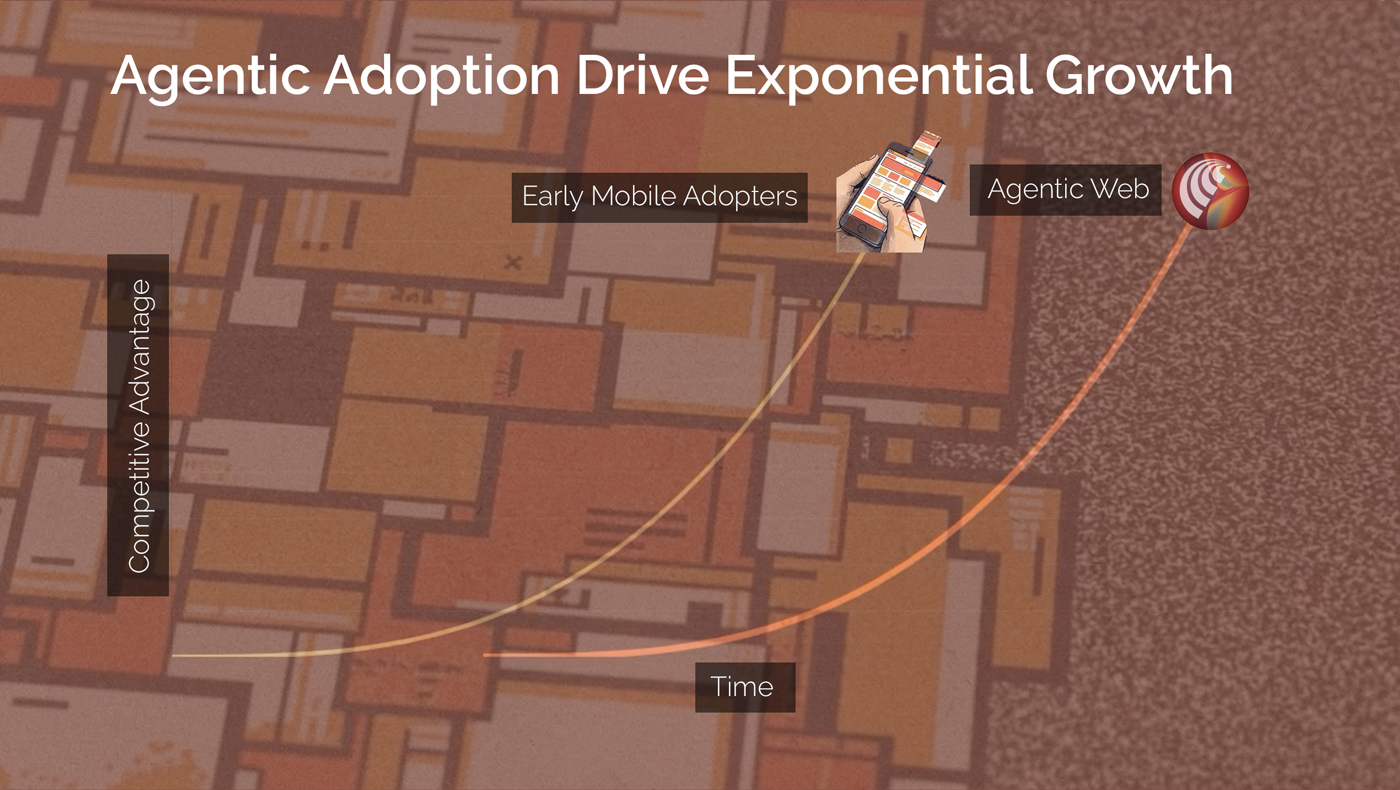
This mirrors what happened with responsive design when mobile traffic scaled. The brands that adapted early captured distribution advantages that compounded over time. Late movers scrambled while traffic had already shifted. WebMCP is setting up the same dynamic for the agentic web.
How Does It Compare to Traditional MCP?
Traditional MCP runs on a separate server and handles backend and API-layer operations. WebMCP runs inside the browser tab, inherits your existing authentication, and operates on your actual website interface. They are complementary rather than competing.
A business might use both. MCP handles headless data operations in the background. WebMCP handles the customer-facing interactions on your site. Think of them as different layers of the same strategy rather than either-or choices.
One current limitation worth knowing: WebMCP handles tool calling only. It does not yet cover resources or prompts, which traditional MCP supports. If your use case requires agents to access structured data sources or documents, traditional MCP is still the right tool for that layer.
Is Your Website Already Ready?
Possibly more than you expect. WebMCP readiness is less about adding something new and more about having built things well to begin with. The question worth auditing now is whether your most important site interactions, the contact form, the booking flow, the service search, use clean and predictable HTML with clear labels.
If your site was built with technical SEO fundamentals in mind, stable redirects, logical form structure, consistent input labeling, you have a solid foundation. If your forms are a tangle of JavaScript workarounds, or key interactions are buried in dynamic components with no semantic structure underneath, that is where the gap lives.
You can begin testing WebMCP today by downloading Chrome Beta, enabling the WebMCP flag at chrome://flags, and installing the Model Context Tool Inspector extension from the Chrome Web Store.
Four Things to Do Before This Goes Mainstream
- Audit your most valuable on-site actions. Lead forms, booking flows, contact pages, product searches. For each, ask: are labels descriptive, are inputs predictable, does the form use clean semantic HTML?
- Check your AI visibility baseline now. Are you being cited in AI-generated answers for your core services? Agents need to find you before they can use your site. Brand presence in AI responses is the top of that funnel.
- Shift how you think about your site’s purpose. The question is no longer just “what does my content say?” It is “what can someone do here, and how easily can a machine figure that out?”
- Start the conversation with your developer or agency. WebMCP is not production-ready today, but the teams who understand it now will implement it cleanly when broader browser support arrives. This is not urgent. It is important.
Ready to Future-Proof Your Brand?
The agentic web is not coming.** It is here.** Two types of users are on the web right now: humans and the agents acting on their behalf. The brands that optimize for both early will have a compounding advantage as AI-driven workflows become normal.
If you want to know where your brand stands in AI search and what it takes to stay competitive as these tools scale, let’s start with what you already have.